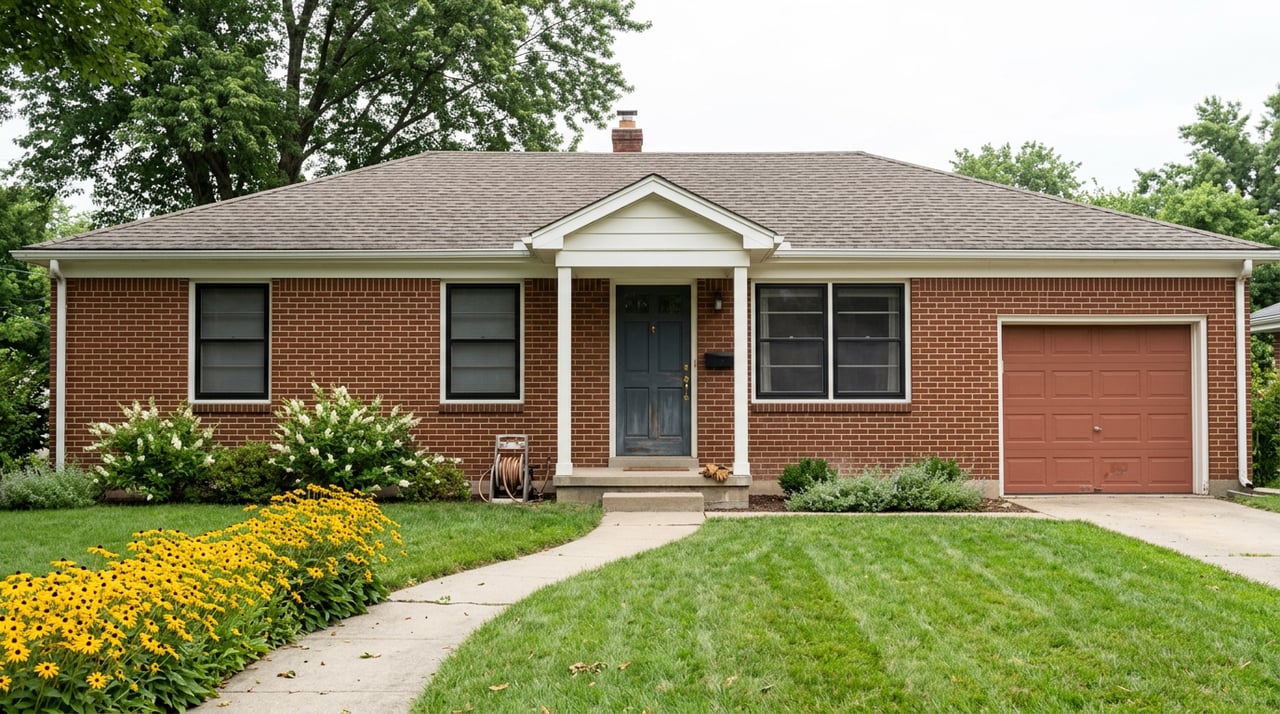
Why a Smaller House in Trenton Isn't Selling for Less
August 13, 2026
August 13, 2026
Take $285,000 to two different corners of Butler County this summer and you'll walk through two different houses. In most of the county, that budget buys something close to 2,100 square feet. In Trenton, the same money is more likely to land you around 1,700 square feet. Same price. Less house.
If you're comparing towns on a spreadsheet, that gap looks like a pricing error. It isn't. It's the clearest signal in the Trenton market right now, and it has almost nothing to do with floor plans or lot sizes.
Trenton's median list price sat at $285,000 in July 2026, with the typical listing spending just 14 days on the market before going under contract, a pace 6% faster than the same month a year earlier. Over that same stretch, homes across Trenton have been averaging close to 1,700 square feet, well under the roughly 2,100-square-foot average found across Butler and Warren counties.
Do the division and Trenton is running around $168 a square foot. That number only makes sense if something other than square footage is setting the price. In Trenton's case, that something is a decade of industrial investment that has nothing to do with home size and everything to do with who's cutting paychecks nearby.
Trenton has never been a bedroom community that got built and then waited for employers to show up. The order ran the other way. The Molson Coors brewery has operated on Wayne Madison Road since 1991, employing more than 500 people, brewing dozens of brands that ship out under names most Ohioans would recognize on a grocery store shelf. That's a working town's anchor employer, and it shaped a housing stock built for people who wanted a solid, modest place close to a steady paycheck rather than a showcase house with room to spare.
Shape Corp added to that pattern more recently, buying 50 acres inside the Trenton Industrial Park to expand its Center for Aluminum Excellence, a facility expansion planned at roughly twice the size of its current operation. None of this shows up in a square-footage comparison. All of it shows up in why people keep moving to Trenton for work first and house second.
The newest chapter is bigger than either of those. Real estate investment trust Prologis closed on a site inside the Trenton Industrial Park, initially described as 141 acres and refined to about 145 in the final approved plans, just east of the Molson Coors brewery and about a mile south of downtown. The land traded at roughly $55,000 an acre, close to $7.7 million total, and the proceeds were reinvested into an additional 216 acres the city intends to develop as the next phase of the same industrial park.
What's going on that land is a data center campus, publicly referred to by the developer as "Project Mila." Early proposals floated a building as large as a million square feet. By the time Trenton's Planning Commission approved the site plan on March 30, 2026, the plan had settled into four buildings at 220,000 square feet apiece, roughly 880,000 square feet total, plus an electrical substation. A panel of local commercial real estate professionals named the land sale itself the Sale/Acquisition of the Year for Cincinnati-Dayton in the 2026 CoStar Impact Awards, calling it one of the largest single land transactions the region has seen.
Not everyone in Trenton is thrilled about it. Barry Blankenship, who lives within half a mile of the construction site, put it plainly to a local news crew before the public forum on the project began:
"My expectation is that they listen to us, our concerns, and, if we are going to get it, it's as safe as possible."
That tension, growth arriving faster than residents can fully weigh in on it, is worth sitting with if you're the kind of buyer who wants to know a town's whole story before you sign anything.
Here's the part that matters most if you're pricing a house against a paycheck. Trenton's finance leadership hasn't been quiet about why this deal matters to them beyond the land sale itself. City officials have pointed to new water, sewer, and stormwater fees from the data center that could bring the city around $120,000 a year, on top of the substantial recurring property tax revenue a facility like this generates without adding the traffic, school enrollment, or service calls that come with new subdivisions.
The City of Trenton's own explanation of the broader industrial push states plainly that a project of this size will provide hundreds of thousands of dollars annually toward schools and public services, revenue the city is explicitly trying to build so it doesn't have to lean as hard on homeowners for it. That's the mechanism behind the price gap. Trenton isn't charging you $168 a square foot because the drywall is nicer. It's pricing in a town that's betting its next decade on commercial and industrial tax dollars rather than on squeezing more out of residential assessments, and buyers are recognizing that bet before it's fully proven out.
None of this is happening in a vacuum where Trenton stays exactly as small as it is today. The city is also moving forward with Trenton Square, a roughly $32 million project on 110 acres of former farmland near West State Street, about half a mile from downtown. The plan pairs a new city building, housing the police department and a YMCA, with separate residential and commercial development on the same land. Cincinnati-based Miller Valentine was selected as the builder, and the city's own materials list banks, restaurants, coffee shops, auto service, convenience stores, daycare facilities, and medical offices as the kinds of private businesses it hopes to attract to the site.
That's relevant for anyone comparing Trenton to a neighboring town today. New inventory near downtown is coming, and it will compete with existing listings once it's built out. A buyer weighing Trenton against Franklin or Monroe right now is comparing today's supply. In three to five years, that comparison could look different.
If you're cross-shopping Trenton against other Butler County communities on price alone, you're missing the part of the story that explains the price. You're not overpaying for a smaller house. You're buying into a town where two things are true at once: the job base is real and growing (a 500-plus person brewery, an aluminum manufacturer expanding its footprint, and roughly 150 new long-term positions coming from a data center), and city leadership is actively trying to keep that job growth from landing on your future tax bill the way it might in a town with no industrial tax base to lean on.
That's a different proposition than "smaller house, same price, bad deal." It's closer to "smaller house, same price, different bet on what keeps your costs predictable ten years from now." Whether that bet is the right one for your family depends on how you weigh proximity to steady employment and a tax strategy aimed at homeowners against the extra square footage that same $285,000 buys you fifteen minutes down the road.
If you're trying to work through that comparison for your own move, whether Trenton, Franklin, Monroe, or another Butler or Warren County community is the better fit, I'd rather walk through the actual numbers with you than let a listing price tell half the story. Regina Miller has been helping Southwest Ohio buyers read markets like this one for years, and she'd love to help you figure out what your money is really buying. Let's Connect.
Stay up to date on the latest real estate trends.
Put your real estate goals first with a dedicated neighborhood specialist focused on delivering peace of mind and exceptional results.